
“Poor Dear Jumbo”: Elephants, Empire and Empathy in Victorian Britain
Dr. Helen Cowie, Lecturer in History, University of York
.


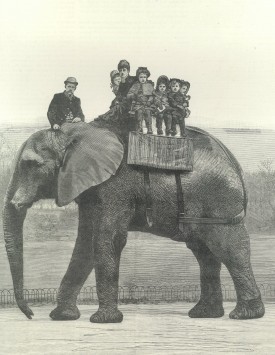
Determined to keep Jumbo in Britain, supporters compiled petitions against Jumbo’s deportation, set up a ‘Jumbo Redemption Fund’ to reimburse Barnum for the cost of the elephant and congregated daily at the gardens to see their huge friend for the last time. According to one report, ‘the Zoological Gardens were visited by 3,615 persons’ on Wednesday 1 March 1882, ‘against 502 on the corresponding Wednesday [the previous] year’.[2]

Other Britons demonstrated their solidarity with Jumbo in even more bizarre ways. A lady whose husband had recently died sent ‘a parcel of crape and widow’s weeds’ to Alice, ‘that she might mourn over her bereavement’. One man christened his son ‘Jumbo’ in the elephant’s honour, while another more practical individual sent Jumbo ‘a box 2 feet square, full of corrective pills’ to prevent nausea during his transatlantic voyage. Many people composed doleful poems about Jumbo, some of which were published in the RSPCA’s monthly magazine, The Animal World.[5] This is just one example:


Abraham Bartlett, the Zoo’s director, denied that African elephants like Jumbo were rare in Europe, estimating that there were currently around thirty throughout the continent. Mr Justice Chitty found for the defence, permitting Jumbo’s removal to go ahead.
.
.
.
.
Jumbo himself had other ideas, refusing to enter the van that Barnum had constructed to transport him to the docks. This act of resistance was interpreted sentimentally as evidence of Jumbo’s love for the gardens and for the female elephant Alice. It was also imbued with patriotic significance, as Jumbo apparently embraced his British heritage and rejected expatriation to the USA.
Following a few false starts when the wheels became bogged down in soggy ground, and a minor crisis when Jumbo’s trunk ‘lighted upon a crowbar’, Jumbo’s keeper Scott and Barnum’s man William Newman escorted him through the streets of London. The roads were lined with crowds of onlookers, who serenaded the cortege by ‘singing “Rule, Britannia” and other airs’.[7]


The elephant endured the passage to America fairly stoically and was greatly cheered on the third day at sea, when ‘the 300 emigrants [on board] visited him, giving him cakes, fruit and bread’. According to one report, Jumbo feasted regularly on ‘hay, oats, bread and onions’, was occasionally given tobacco, which ‘made him thoughtful and indignant’, and quaffed liberal quantities of whiskey, which ‘made him affectionate’.[9]
To maximise public interest in Jumbo, Barnum purposefully alluded to the sorrow that had accompanied the elephant’s departure in Britain, distributing publicity pamphlets in which ‘the whole British nation, headed by Queen Victoria, is represented as clinging tearfully to Jumbo’s tail’.[10] Barnum also emphasised Jumbo’s size and docility, describing him as ‘the largest and heaviest elephant in the world’, and the ‘children’s giant pet’.

Jumbo toured with Barnum’s Circus until September 1885, when he was hit and killed by a train in Ontario, Canada. Barnum romanticised Jumbo’s death, claiming that he had ventured onto the railway line to rescue the baby elephant, Tom Thumb. It seems more likely, however, that he disobeyed orders and strayed onto the tracks. The Standard reported that ‘refusing to stand aside upon the approach of a goods train he was…taken up by the engine, carried forwards a hundred yards and finally crushed against some trucks’.[11]

.
One of the reasons Jumbo HAD to be sold, however, was because British sensitivities prevented the use of harsh traditional methods to tame a rogue elephant, rendering him a danger to the public. In an interview with the Daily News, Zoo Director Abraham Bartlett described how, in India, ‘a fractious animal…is securely chained and flogged till his excitement abates’, or might be subdued with the assistance of a special ‘fighting elephant’ kept for the purpose.
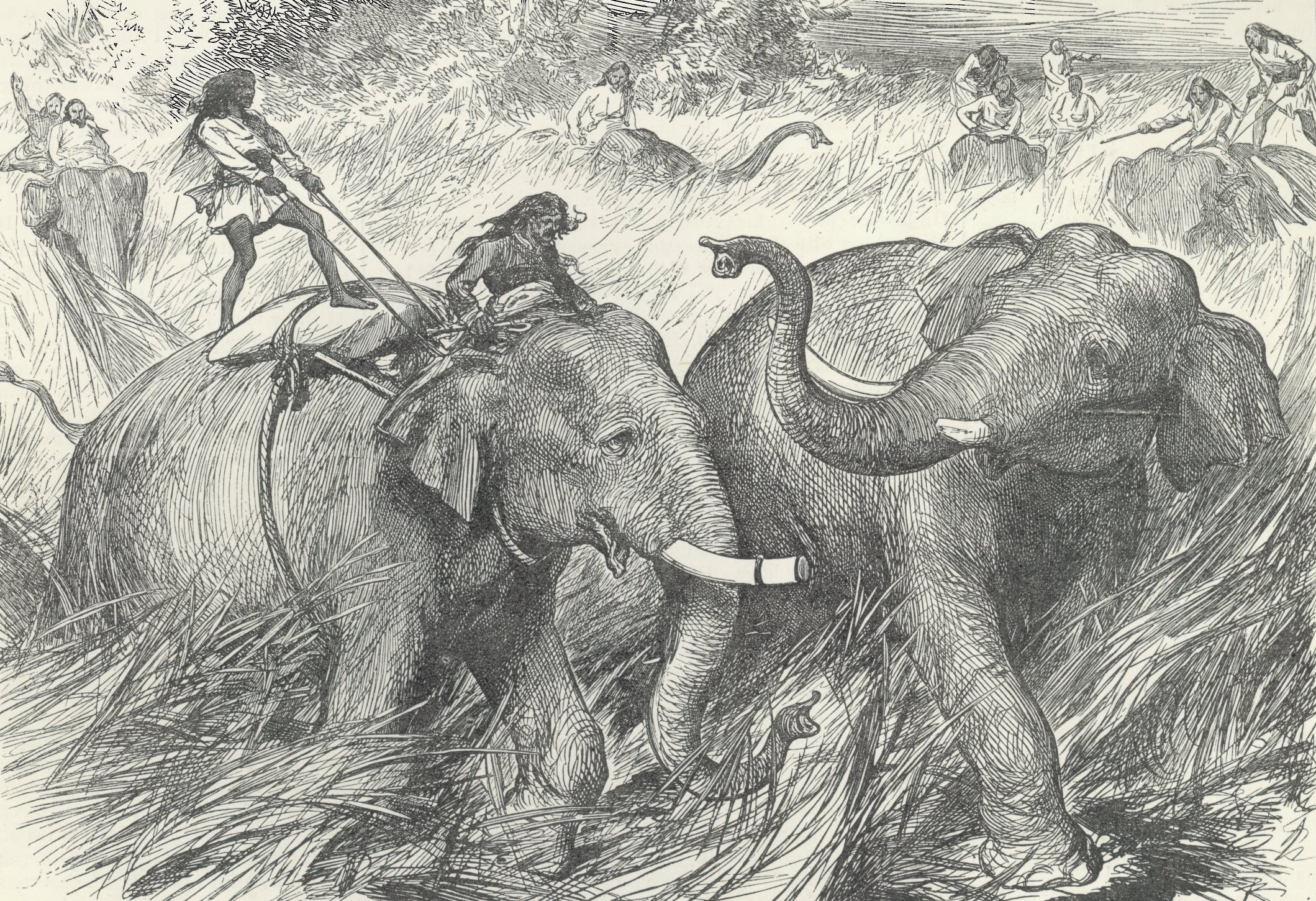
Bartlett appeared to favour this latter technique, but admitted that such a brutal approach could not be taken in Britain, for ‘any “taming” of this description…would, if adopted here, raise such an outcry against the Zoological Society as would compel them to desist’.[12] This image shows a tame elephant being used to subdue a wild elephant in Nepal during the Prince of Wales’ visit to India in 1876.
.
.
.
.


Jumboism: Not everyone cared for Jumbo, however, and the sentimentalism shown for the elephant soon generated a negative backlash against ‘Jumboism’. As the furore over Jumbo’s departure grew, some commentators argued that public sympathy for the elephant was excessive, and ought to be channelled into more worthy causes. The paper World satirised the hypocrisy of those individuals ‘who pride themselves in refusing a penny to a street beggar’ but ‘hasten to send cheques to buy Jumbo’.[15] Another observer concluded that much of the anguish expressed for Jumbo was ‘mere sentimental gush’, which distracted contemporaries from more routine abuses of animals.[16] The hysterical attentions lavished on a single elephant were deemed unwarranted in a society where human suffering was frequently overlooked and where more endemic forms of animal cruelty went unchallenged. This view prefigures the criticism that is sometimes levelled today at the public for favouring animal over human charities or for confining their compassion for animals to the most cuddly or iconic species.
.
[1] Baroness Burdett Coutts, ‘Reflections on the Sale of Jumbo’, The Animal World, June 1882
[2] Leeds Mercury, 4 March 1882
[3] Leeds Mercury, 4 March 1882
[4] Lloyd’s Weekly Newspaper, 19 March 1882
[5] ‘Jumbo’, The Animal World, March 1884
[6] Standard, 8 March 1882
[7] Morning Post, Thursday March 23, 1882
[8] Morning Post, Thursday March 23, 1882
[9] Star, Tuesday April 11, 1882
[10] The Graphic, 15 April 1882
[11] Standard, Thursday September 17, 1885
[12] Daily News, 25 February 1882
[13] Standard, 8 March 1882
[14] Standard, 21 February 1882
[15] Bristol Mercury, 9 March 1882
[16] ‘Snake Feeding’, The Animal World, December 1882
 Dr. Helen Cowie, “‘Poor Dear Jumbo’: Elephants, Empire and Empathy in Victorian Britain”
Helen Cowie is lecturer in history at the University of York. Her first book, ‘Conquering Nature in Spain and its Empire, 1750-1850′, was published by Manchester University Press in 2011. Her second book, ‘Exhibiting Animals in Nineteenth-Century Britain: Empathy, Education, Entertainment’, is forthcoming with Palgrave Macmillan. Helen’s research interests include the cultural history of science, the history of leisure and the history of animals.
For Authorship:
 Conquering Nature in Spain and its Empire, 1750-1850 (Manchester: Manchester University Press, 2011): http://www.manchesteruniversitypress.co.uk/cgi-bin/indexer?product=9780719084935
Exhibiting Animals in Nineteenth-Century Britain: Empathy, Education, Entertainment (Basingstoke: Palgrave Macmillan, forthcoming 2014)
For Background:
.
.