
Kipling’s Menagerie: Human-Animal Relations in the Works of Rudyard Kipling
Chelsea Medlock, Ph.D. Candidate, Oklahoma State University
.
Kipling’s poetry and stories contained within his three most famous works are a microcosm of both imperialistic sentiment and the colonial tensions within human-animal relations. The vast majority of these poems and stories speak to man’s complex relationship with colonial animals and by extension Britain’s relationship or view of their territorial holdings. Much of Kipling’s animal works illustrate the view that the colonies were wild and savage compared to Victorian Britain and that it was the role of the British Government and military to control, guide, and mold the colonial lands by force if necessary. Within these three works, one can find three major themes regarding human-animal relations: the use of animals as instruments of imperialism, the dangers of the wilderness, and the “civilizing” of nature by man.


For much of the nineteenth century, military animals were the main form of land transportation used by the British to conquer India. Kipling illustrates this fact through the use of the common species of military animals in “Her Majesty’s Servants” and “Parade-Song of the Camp Animals,” both of which were published in 1894 in The Jungle Books.
In his first work, “Her Majesty’s Servants,” the story follows the conversations of camp animals, as overheard by the human narrator one wet night after a stampede of baggage camels disturbs the peace of the camp. The speakers are a mule, a camel, a cavalry horse, an ox, and an elephant, all of whom labor in the military camp in India. The narrator hears the animals discuss their individual duties in the camp as well as their feelings of the work. The mule talks about how he has to keep his focus in all of those precarious places that the soldiers take him, the horse speaks to the need to trust his rider when going into battle, the ox complains that he and his friends have to pull the field guns when the elephants refuse to continue working to which the elephant retorts that he stops working because he knows what is coming on the battlefield and no one seems to hear his warnings.


Like “Her Majesty’s Servants,” “The Parade-song of the Camp Animals” is about a train of military animals discussing their roles in the British military in India; this includes elephants, oxen, horses, mules, and camels. The elephants and the oxen state that it is their jobs to move the guns of war while the horses exalt their relationship with their rider, charging into battle, the mules warn the train that bad luck comes to the driver who cannot pack a load properly, and the camels march to a beat of their own – humming and hawing as they work. Despite the dangers and the hard labor, the camp-animals agree by the end of the poem that it is their primary role in life to work for humans, especially in the areas of conquest and war, stating: “children of the camp are we, serving each in his degree, children of the yoke and goad, pack and harness, pad and load.”

The second major theme in the works of Rudyard Kipling is the dangers of the wilderness and the threat wild animals pose to humans (the British) if man does not bring order to the chaos of Mother Nature. One of the most popular stories from The Jungle Books is the tale of “Rikki Tikki Tavi.”
The story follows the adventures of a mongoose, who is adopted by a British family living in India. The story centers on his deadly encounters with a family of cobras, living in the bungalow’s garden. Rikki saves the family not once but three times from the dangers of the Indian wilderness: first from Nag, then by smashing the cobra eggs, and finally, by defeating Nagina in the climatic final scene. Rikki’s purpose in the story is to protect his adoptive family not just because they saved him but also because that is part of his natural instinct to kill venomous snakes. In the final climatic scene between Rikki Tikki and Nagina, the mongoose valiantly protects his adoptive family while also ridding the garden of the numerous potential threats from the uncontrollable wilderness (King Cobras). As Nagina is about to strike Teddy, the son, Rikki confronts her, holding her last egg. “What price for a snake’s egg? For a young cobra? For a young king cobra? For the last – the very last of the brood? The ants are eating all the others down by the melon bed, “ taunts the mongoose. The enraged snake strikes at Rikki, before grabbing her last egg and slithering down her hole in the garden. The mongoose pursues her and emerges victorious, saving the British family and the rest of the animal inhabitants from the deadly cobras; thus, bringing safety and order to their tiny part of India.

Like the dangers of the bungalow’s garden, the story of “The Undertakers,” included in Kipling’s work The Second Jungle Book, focuses on the threats to man by wild animals in India, particular near rivers. “The Undertakers” is the story of a conversation between a crane, a jackal, and a crocodile. The crocodile boasts about all of the villagers that he has terrorized and the number of humans that he has eaten, especially the ones who fell off the bridge that was being built near the village. After a while, the crocodile falls asleep but the crane and the jackal hear the approaching voices of two British men, carrying guns. The men see the crocodile and shoot him because of how the crocodile had terrorized one of the man’s family when the man was younger. The body is then carried to the neighboring village to be chopped up. The Jackal tells the Crane that that was worth the stay, particularly to see one of the dangers of the river subdued by man.
.

The Law of the Jungle discusses the various legal codes that all of the animals living in the jungle must abide by; otherwise they will be punished for breaking it. Finally, Mowgli’s father expresses one of the most important laws of the jungle, never kill humans. “Ye may kill for yourselves, and your mates, and your cubs as they need, and ye can, but kill not for pleasure of killing, and seven times never kill Man.” This implies that the killing of man is the worst offense to the law of the jungle, it also implies that the killing of man will bring revenge and punishment upon the jungle for overstepping its boundaries. The point of the Laws is to bring order, stability, and control to the chaos of the wild jungle. The animals are told their place in the world and ordered to obey the law of the jungle at all costs: “Now these are the laws of the jungle, and many and mighty are they, but the head and the hoof of the law and the haunch and the hump is – OBEY.”
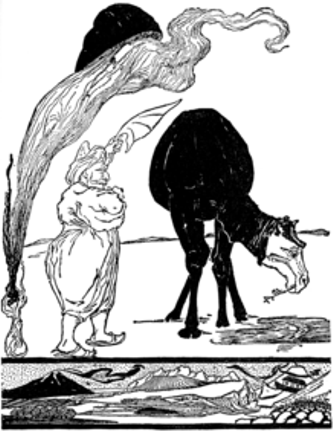
In the Just So Stories, Kipling writes that when animals were first domesticated by man, the dog, the horse, and the ox were compliant with the demands of man. The camel, on the other hand, was lazy and idle and refused to work for humans. The other animals felt that the camel was not pulling his share of the work so they complained to Man, who could do nothing. So the animals went to a Djinn, who told the camel that he needed to work for man, like the others. The camel replied with a “Humph.” So the Djinn turned the camel’s “Humph” into a hump, which makes the camel work longer without food or water, thus punishing the camel for his laziness in the face of man’s demands and for resisting the orderly influence of man (and by extent, white man).
Animals play a very prominent role in the works of Rudyard Kipling, especially within his children’s literature. While Kipling’s animals represent a diverse array of species personalities, and imperial roles, it is clear that many of his representations fall within three major themes of imperialism and the use of imperial animals. Whether the animals are involved in the confrontation between civilization and the wilderness, of the natural laws between man and beast, Rudyard Kipling makes an excellent micro-study in the basics of human-animal relations.